Lumi — Plan Your Ride Home
A privacy-first, harm-reduction approach to reducing impaired driving in Australia
Abstract
Impaired driving remains one of the most persistent and preventable causes of road death in Australia. Decades of random breath testing (RBT) and public education have driven a substantial long-term decline, yet drink driving still contributes to a meaningful share of fatal crashes, and behavioural surveys show that many drivers will still consider getting behind the wheel after drinking. Although ride-hailing has measurably reduced alcohol-related crashes internationally, the decision to use it still depends on an impaired person making a sound judgement in the moment, precisely when that judgement is least reliable. This paper argues that a free, privacy-first mobile application that pre-arranges a safe ride while the user is still sober, and reduces the night-of action to a single tap, addresses a real and currently under-served gap in the Australian market. It further argues that the application’s deliberate refusal to estimate intoxication, a feature common to older apps, is both its principal safety advantage and its clearest point of differentiation.
1. Introduction
In Australia, the general legal limit is a blood-alcohol concentration (BAC) of 0.05, with a zero limit for learner and provisional drivers. Most interventions against drink driving target one of two moments: the decision to drink, or the decision to drive afterward. The second is the more dangerous, because it is made by a person whose capacity to judge their own impairment is already compromised. Smartphone ownership is near-universal among the demographics most affected, which makes the phone a natural vehicle for intervention, provided that the intervention is designed for an impaired user rather than an idealised sober one. Lumi is a proposed free application, released initially on Android with iOS to follow, and is built on a single principle: complete the planning while the user is sober, so that getting home safely later requires almost no decision at all.
2. The Case for Action: Impaired Driving in Australia
Australia has made real progress against drink driving, largely through sustained enforcement. National crash data indicate that the share of fatal crashes involving a drink driver fell from roughly 21.6% in 2010 to about 12% in 2023, a public-health success attributed to decades of random breath testing and sustained education campaigns [1]. The scale of that enforcement is considerable: in 2024, Australian police administered approximately 10.3 million random breath tests [1].
Even so, drink driving remains a leading and preventable contributor to road trauma. In Victoria, approximately one in five drivers and motorcyclists killed on the roads record a blood-alcohol concentration above the legal limit [2]. The behavioural risk also persists: the Transport Accident Commission’s most recent Road Safety Monitor, an annual survey of 2,500 Victorian licence holders, found that 41% of Victorian drivers admit to driving after drinking and that 48% would consider driving after two or more drinks [3]. Crash risk roughly doubles once a driver exceeds 0.05 [3]. These figures sit against a national road toll that remains stubbornly high, with 1,300 deaths recorded in 2024 [4], and a National Road Safety Strategy 2021–2030 that commits the country to halving annual road deaths over the decade [5].
The persistent gap lies not in whether a safe ride is available, but in whether it is used. The friction within that gap (opening an app, typing an address, judging whether one is “fine,” and weighing the inconvenience of leaving a car overnight) is precisely where people rationalise driving. An effective tool must therefore remove that friction in advance, because it cannot be removed reliably at the moment. No widely available option in Australia is purpose-built around this insight.
3. The Market Gap: A Review of Available Options
The current landscape contains three categories of solution, none of which occupies the specific niche this project targets.
Ride-hailing services and subsidised ride programs. Ride-hailing (Uber, DiDi, Ola and others operating in Australia) is the dominant, effective solution; international research published in the Journal of the American Medical Association and summarised by road-safety advocates associates its availability with a substantial reduction in motor-vehicle crash traumas [6]. Local clubs, councils and venues sometimes run “safe ride” or courtesy-bus schemes. These are valuable but general-purpose: they still require in-the-moment setup and offer no pre-arranged, single-tap safety net tailored to a night out.
Commercial designated-driver services. Several operators will drive a patron and their car home for a fee. Useful, but paid, geographically limited, and addressing a different need.
Older “anti-drink-driving” and government apps. These come closest to the proposed concept, but they are typically dated and single-jurisdiction. More importantly, many bundle a feature that is both unreliable and unsafe: an estimator that calculates a user’s BAC from self-reported drink counts, weight and time, sometimes alongside reaction-time “games” [7]. This is the critical flaw. Such estimates depend on food, hydration, medication, metabolism and mis-judged drink strength, and they can return a falsely reassuring result that encourages an impaired person to drive. That is the opposite of the intended effect. As Australian road-safety messaging itself stresses, the only fail-safe approach is to separate drinking and driving entirely, rather than to estimate a number.
The gap, therefore, is a modern, cross-platform, free, privacy-respecting planner that deliberately makes no impairment judgment whatsoever and instead makes the safe option effortless. That niche is not well occupied today.
4. Why a Planner, and Not Simply a Ride-Hailing App?
The most natural objection to the Lumi project is also the most important to answer honestly: if a person can open Uber, DiDi or Ola when impaired, what does a separate app add? The candid answer is that for some users it adds nothing, and the project does not pretend otherwise. Ride-hailing is excellent at what it does, and the Lumi project proposal is to complement it rather than to compete with it. The case for a planner rests on a distinction in kind, not in quality.
A ride-hailing app is a transport tool: it executes a decision the user has already made. A planner is a behaviour tool: it helps the user make a pre-committed decision while sober. These operate at different layers. Impaired-driving deaths occur not because ride-hailing is unavailable, since it is on almost every phone, but because the people who could have opened it did not. The problem was never the availability of the ride; it was the in-the-moment decision to take it. A planner addresses the problem since the decision to use it has already been made and planned.
Three further differences follow from this.
The decision is moved to the right self at the right time. Ride-hailing depends on the impaired self, characterised by the worst judgement, the highest overconfidence, and the most active rationalisations (“I’m fine,” “it’s only ten minutes,” “I’ll get the car tomorrow”). A planner instead engages the sober self in advance, applying the well-established principle of pre-commitment that underlies scheduled reminders and similar tools.
Friction is decisive when a person is impaired. The steps a sober person ignores, such as opening the app, confirming the address and accepting the price, each become an excuse to reach for the car. Reducing the journey home to a single pre-configured tap therefore matters disproportionately at the moment it counts.
A ride-hailing app’s failure state is a dead end: when there are no cars, the price surges, or the signal drops, its answer is nothing, and “nothing” is precisely when an impaired person walks to their vehicle. The planner’s failure state, by contrast, cascades to other safe options: calling a trusted person, a taxi, or public transit.
A planner also covers risks that ride-hailing does not touch at all: the car left behind (and the next-day hassle that tempts driving home now), the morning-after drive while still over the limit, and the question of whether someone arrived home safely. None of these is a ride-booking problem, and none has a ride-hailing answer.
Limitations: Which the Lumi acknowledges directly: the person organised enough to install and configure a safe-ride planner while sober overlaps substantially with the person who would have used a ride-hailing app in any case, while the most reckless drivers may never install it at all. The response is twofold:
Behavior is not binary. Much road trauma comes not from a hardened, incorrigible few, but from ordinary people who meant to be sensible and made a single poor decision in the moment. Pre-commitment is aimed squarely at that persuadable majority.
Distribution is the deliberate answer to the install gap. The planner is not meant to be found by an impaired person at midnight; it is meant to reach people at sober, receptive moments, through the institutions that already shape those moments: universities at orientation, venues and clubs, workplaces, and road-safety campaigns during high-risk periods.
In short, the Lumi planner is not a better way to obtain a ride than ride-hailing; it is a low-cost behavioural layer that sits above ride-hailing and enforcement, making the safe choice both decided in advance and friction-free, and providing a fallback when the ride does not come. It will not stop a determined drink driver, and it replaces neither ride-hailing nor random breath testing. Its value lies at the margin, with the persuadable majority; in road safety, that margin is where lives are saved.
5. How Lumi Works
Lumi is organised around plans that are made while sober: all meaningful work happens during a brief sober setup, which collapses the night-of experience into a single action. It is built from a single cross-platform codebase and is released initially on Android via Google Play, with iOS to follow. The application runs entirely on the device.
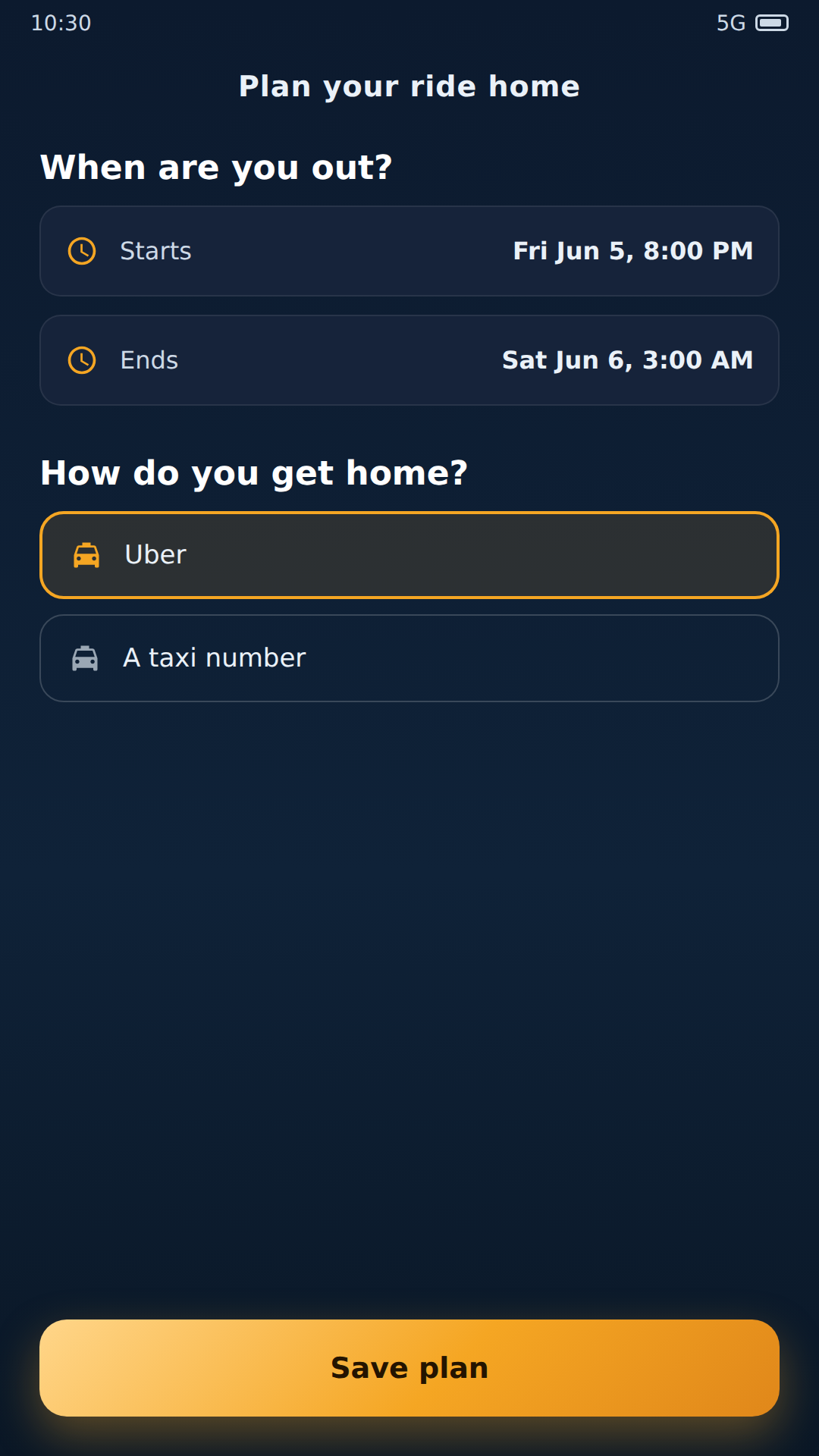
Plan your ride home (sober setup). The core unit is a plan for a night out, comprising a start and end time and, for each plan, a home address, a preferred ride option (Uber, Lyft, another ride app, or a local taxi number) and up to two trusted contacts. Plans are created, edited and deleted by the user and stored only on the device. The home location can be set by address search, by current location, or by dragging a pin to the exact spot on a map, so that the ride’s drop-off is precise.
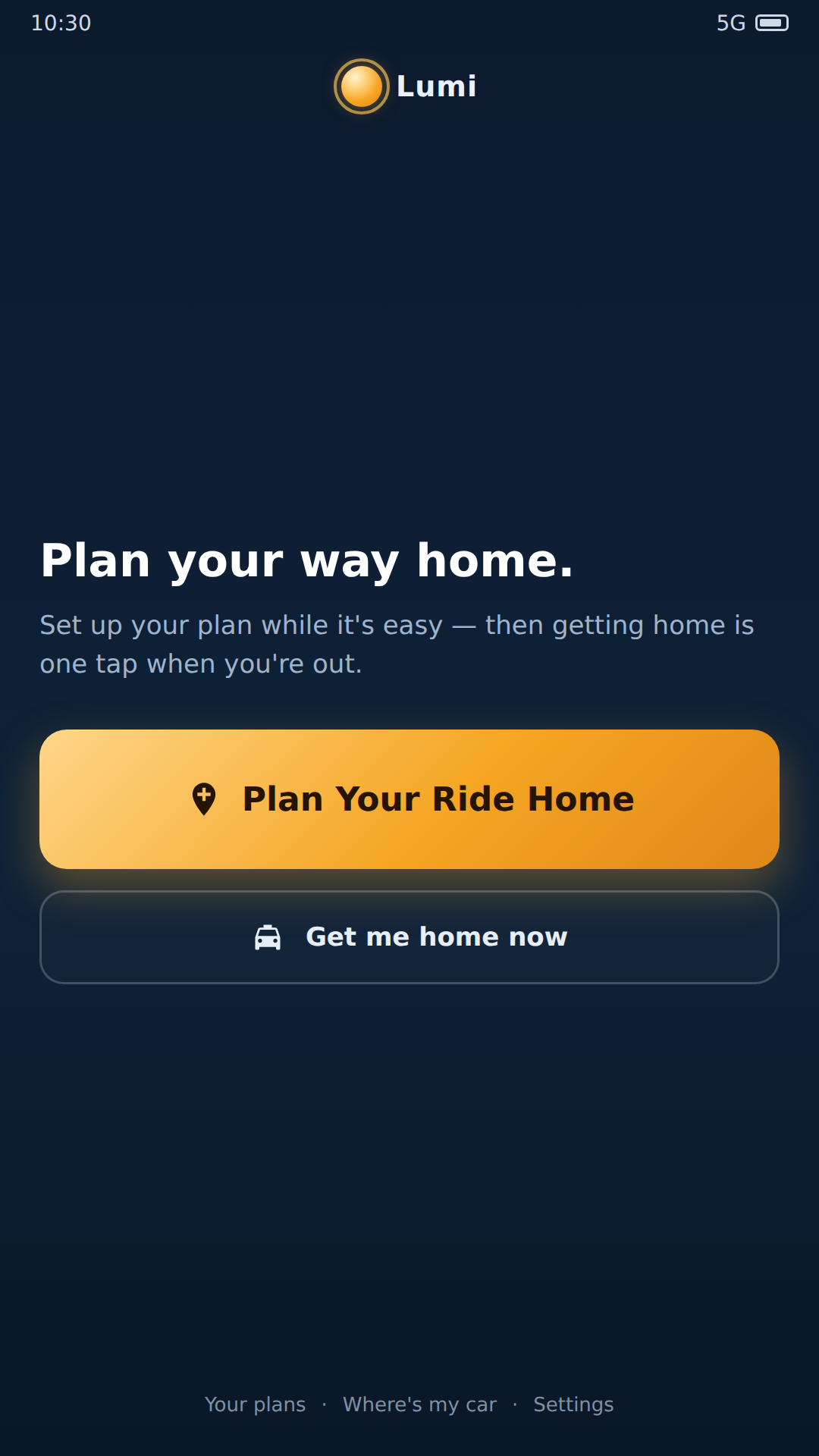
Time-aware home screen. The app chooses what to display based on the current time: during a plan’s window it presents the night-of screen, and outside any window it shows a landing screen led by a single “Plan Your Ride Home” action. The switch happens automatically at each plan’s start and end.
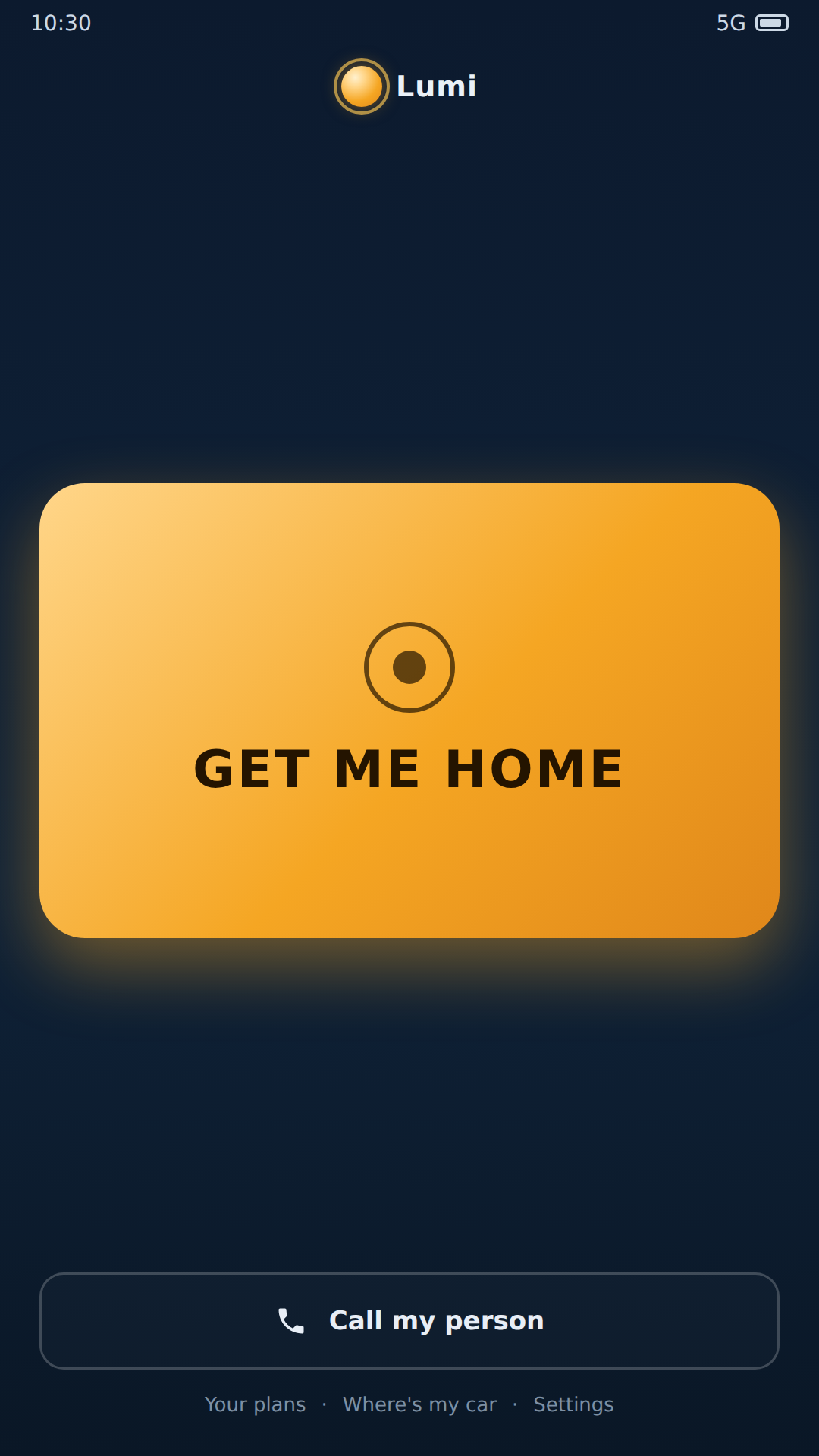
One-tap ride home. On the night-of screen, a single dominant GET ME HOME button launches the chosen ride app with home already set as the destination, leaving the user one confirmation away from a booked ride and requiring no typing. The app attempts the installed application first, then falls back to a web link.
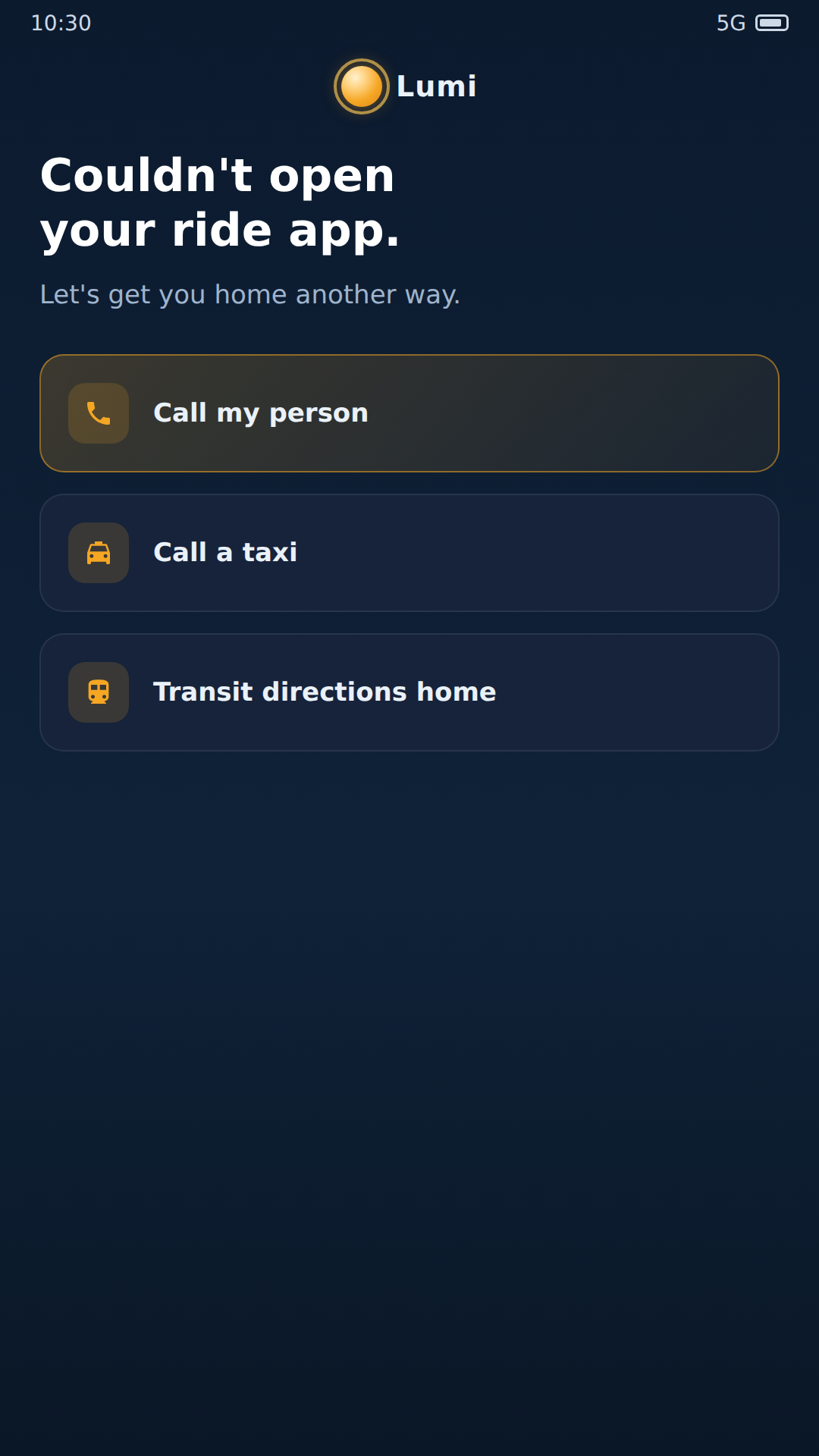
A fallback that never dead-ends. A ride cannot always be obtained: the app may not be installed, there may be no signal, or prices may have surged. In those cases, the app immediately surfaces an ordered set of safe options (calling a pre-chosen person, calling a taxi, or transit directions home) rather than a blank screen. This path is guaranteed never to be empty.
Always one tap from safety. Because an impaired person may open the app without an active plan, a “Get me home now” action is also present on the landing screen. It draws on the nearest plan’s details, or falls back to a taxi or transit if no plan exists, so that it never dead-ends.
A quiet active-plan reminder. While a plan is active, an ongoing, silent notification carries a one-tap GET ME HOME action, so the safe action remains reachable without opening the app. It is delivered by the operating system on a schedule, requiring no background service and incurring no measurable battery cost.
Reach a trusted person. A one-tap call to a contact chosen in advance, while sober.
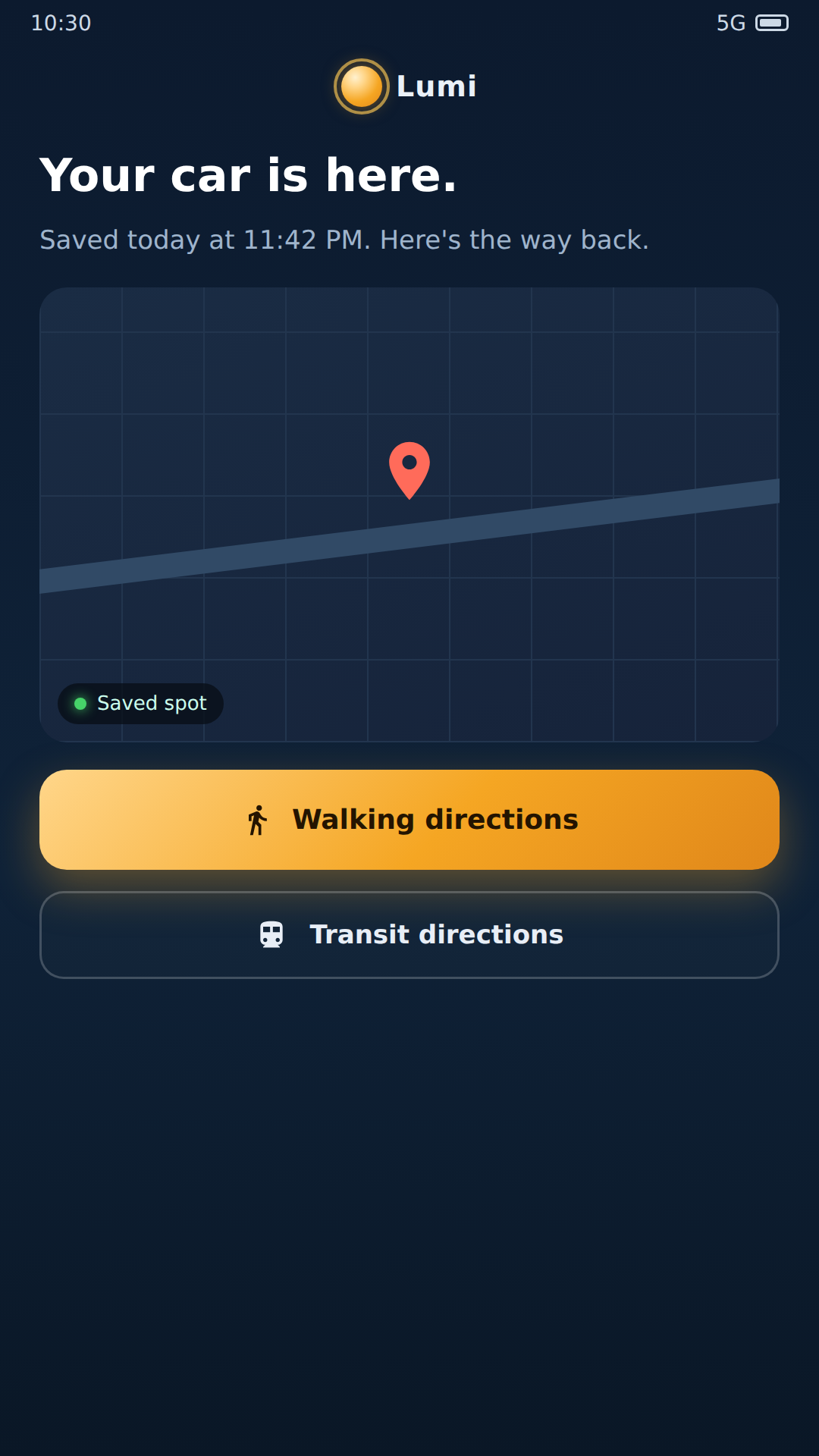
Where’s my car. Saves the parking location on a live map and provides walking or transit directions back to it the following day, removing a common and under-appreciated reason that people drive home impaired.
Morning-after caution. A gentle, opt-in reminder that alcohol can linger into the morning, framed as awareness and never as clearance to drive.
Optional safe-arrival check. A user-armed prompt to mark oneself home safe. If it is missed, the app helps the user notify a trusted contact by opening a pre-filled message that the user must send. The app never sends anything automatically and deliberately uses no automatic-SMS capability: it is built around consent, not surveillance.
6. Design and Ethical Principles
Three commitments distinguish the project. First, it never estimates impairment or tells anyone they are safe to drive, which is the single design choice that most separates it from prior apps and the one that most directly protects users. Second, privacy by design: the application runs entirely on-device, with no backend, account or data collection; a user’s address, contacts and location never leave their phone. This is both an ethical stance and a practical necessity, since location and contact data can endanger vulnerable users if mishandled. Third, honest framing: the app is presented as one layer of safety, never a guarantee.
7. Community Benefit
The benefit the project ultimately seeks is a measurable contribution to road safety. By making a pre-arranged safe ride the easiest option at the moment of decision, Lumi aims to move a share of would-be impaired drivers toward getting home safely. Road-safety outcomes are determined at the population level, so even a modest shift, spread across a community and concentrated in the high-risk occasions the app is built for, would mean injuries and deaths avoided. This aim contributes directly toward the National Road Safety Strategy’s target of halving annual road deaths by 2030 [5]. It should be understood as an objective to be evaluated rather than a proven effect: the credible test is a pilot with an institutional partner that measures uptake and, where the data allow, outcomes.
The project is conceived as a free, non-commercial public good. Because its growth depends on reaching people before a night out, its natural distribution partners are the bodies already invested in this outcome: state road-safety agencies such as the Transport Accident Commission (Victoria) and Transport for NSW, the Commonwealth Office of Road Safety, local councils, universities, licensed venues and road-trauma support organisations. A free, modern and trustworthy tool gives these bodies something concrete to promote at orientation events, in venues, and around high-risk periods such as holidays and major sporting and festival seasons. Promoting it would extend their reach at near-zero marginal cost, while fully respecting the privacy of the citizens they serve.
8. Limitations
In the interest of accuracy, the project’s scope is deliberately bounded. It cannot measure impairment, and does not try to. It depends on sober pre-installation and setup, which is a genuine adoption challenge, and its effectiveness is contingent on the availability of ride services, which is weaker in regional and rural areas where drink-driving risk is also high. Finally, the cited statistics are drawn from the periods, jurisdictions and methodologies of their sources, and should be read as indicative of scale rather than as precise national constants. The application reduces friction toward the safe choice; it cannot guarantee that choice will be made.
9. Conclusion
Australia’s enforcement-led approach has cut drink driving substantially, but it has not eliminated it, and the residual risk is concentrated in precisely the in-the-moment decisions that enforcement cannot reach. Existing tools either require the impaired person to act sensibly in the moment or, worse, offer an unreliable impairment estimate that can license a dangerous decision. Lumi occupies the under-served middle ground: a free, cross-platform, privacy-first planner that does its work while the user is sober and makes the safe option effortless when it matters. Its central design choice, namely to make no judgement about whether someone can drive and simply to make getting home easy, is at once its ethical foundation, its safety advantage and its market differentiator. Paired with Australian institutional distribution, it offers communities a low-cost, high-integrity complement to the random breath testing, ride-hailing and public programs already shown to save lives. Lumi is not a cure for impaired driving, and it does not claim to be: it is one modest, complementary layer whose real-world effect remains to be measured. The logical next step is a small pilot with an institutional partner, designed to test uptake and, where the data allow, its contribution to getting people home safely.
References
[1] The Conversation / University of Melbourne (2025). “Australian drug driving deaths have surpassed drink driving. Here’s how to tackle it.” Reporting national crash data: drink-driving involvement in fatal crashes fell from ~21.6% (2010) to ~12% (2023); ~10.3 million random breath tests conducted in 2024. theconversation.com.
[2] Transport Accident Commission (TAC), Victoria (Road Safety Monitor; TAC media release, 26 November 2025), and Victoria Police Road Safety Strategy 2024–2028: around one in five drivers and motorcyclists killed on Victorian roads record a blood-alcohol concentration above the legal limit. tac.vic.gov.au; police.vic.gov.au.
[3] Transport Accident Commission (TAC), Victoria — Road Safety Monitor, an annual survey of 2,500 Victorian licence holders (figures as reported by the TAC, November 2025): 41% of Victorian drivers admit to driving after drinking and 48% would consider driving after two or more drinks. Casualty crash risk roughly doubles just above 0.05 BAC (National Road Safety Partnership Program / CARRS-Q). tac.vic.gov.au; nrspp.org.au.
[4] Bureau of Infrastructure and Transport Research Economics (BITRE), Road Trauma Australia 2024 (September 2025), based on the Australian Road Deaths Database: 1,300 road deaths in Australia in 2024. bitre.gov.au.
[5] Australian Government, Office of Road Safety — National Road Safety Strategy 2021–2030 (target: halve annual road deaths by 2030). roadsafety.gov.au.
[6] Mothers Against Drunk Driving (MADD). “Safe Ride.” madd.org/drunk-driving/safe-ride/ — citing a Journal of the American Medical Association study associating ride-hailing availability with reduced motor-vehicle crash traumas (international supporting evidence).
[7] Wisconsin Department of Transportation, “Drive Sober” app (App Store listing); Tom’s Guide, “Best Apps to Stop Drinking and Driving” — examples of prior apps bundling drink-based BAC estimators and reaction-time games. (Illustrative of the design flaw this project avoids.)
[8] Apple App Store Review Guidelines; Google Play Developer Program Policies — provisions on health/safety claims and alcohol-related content (accessed 2026).
Appendix A — Interface Screenshots
The following are screenshots of the implemented application (Lumi). They show how it front-loads all setup to a sober moment and reduces the night-of interaction to a single, unmissable action, and how every fallback hands off to another safe option rather than dead-ending.

Prepared as a project justification and background document for an Australian audience.
Lumi is developed by Cognideep. Further information is available at .